
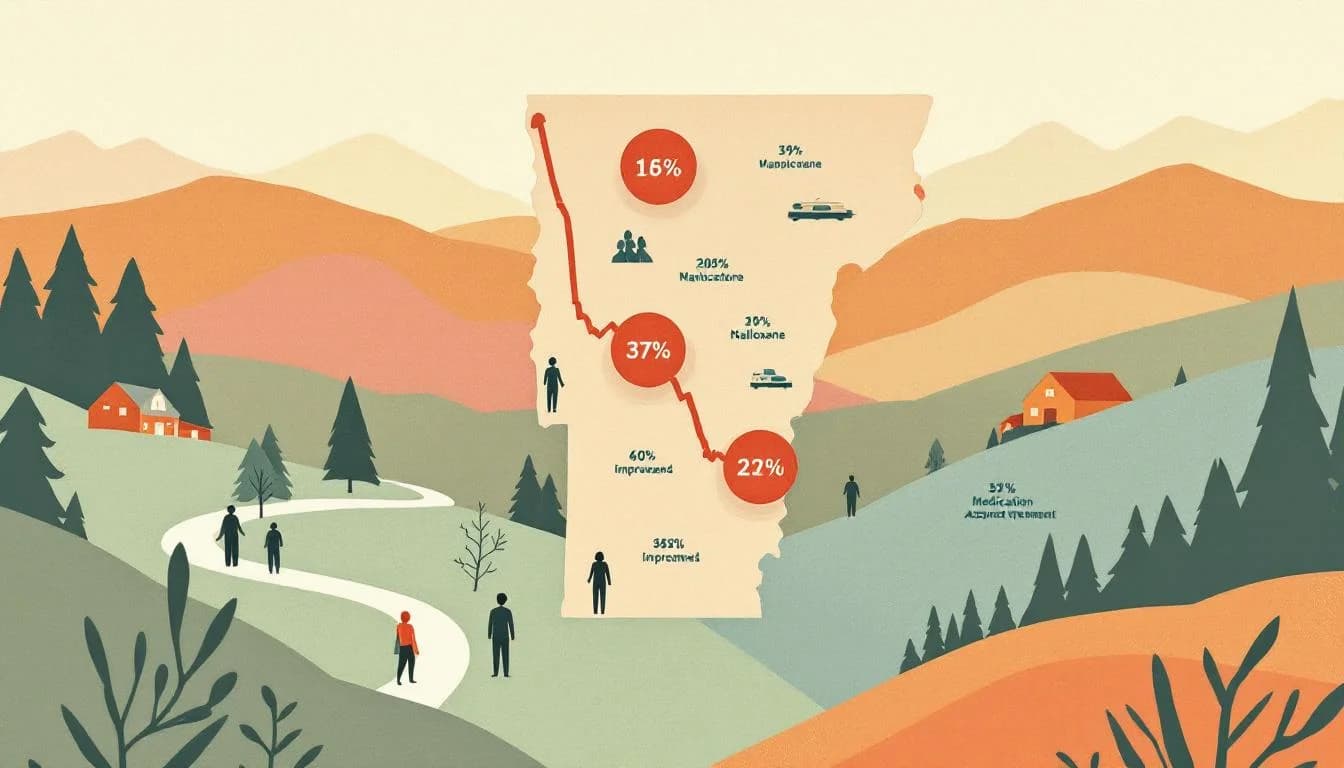
Vermont Overdose Deaths Plunge 25% in First Decline in Two Decades
Vermont has achieved something it hasn't managed in twenty years: a substantial reduction in drug overdose deaths. Preliminary data from the Vermont Department of Health show fatal overdoses dropped by approximately 25% between 2024 and 2025, falling from roughly 225 deaths to about 170. The decline marks a significant departure from two decades of steadily climbing mortality that made the Green Mountain State an unlikely epicenter of New England's opioid crisis.
The improvement arrives as Vermont mirrors a broader national pattern. Across the United States, overdose deaths have fallen roughly 19% since peaking in August 2023, representing the longest sustained decrease in more than four decades. Yet Vermont's achievement stands out for its magnitude and timing. While larger states with more resources have posted gains, Vermont's 25% reduction exceeds the national average and represents a dramatic reversal for a jurisdiction that had seemed trapped in an unrelenting upward spiral.
A Rural State's Persistent Struggle
Vermont's overdose crisis developed along distinctive contours shaped by its rural character and geographic isolation. The state's sparse population, dispersed across mountainous terrain and small towns, created barriers to treatment access that urban-centered interventions struggled to address. When fentanyl began saturating northeastern drug markets in the mid-2010s, Vermont's limited healthcare infrastructure proved ill-equipped to respond at scale.
The results proved devastating. Between 2014 and 2022, Vermont's overdose death rate more than tripled, climbing from roughly 10 per 100,000 residents to over 30. The state consistently ranked among the highest overdose mortality rates nationally, an unexpected distinction for a jurisdiction with fewer than 650,000 total residents. Rural counties, where distances to treatment providers could exceed an hour's drive, experienced disproportionate impacts.
What Changed
Multiple factors likely contributed to Vermont's mortality decline, reflecting both state-specific initiatives and broader shifts in the national response to the opioid crisis.
Expanded naloxone distribution has transformed overdose response across Vermont. The Health Department's aggressive community distribution programs have placed the life-saving medication in pharmacies, community organizations, and public spaces statewide. Vermont was among the first states to authorize pharmacist-initiated naloxone dispensing without individual prescriptions, removing bureaucratic barriers that delayed access during emergencies.
Medication-assisted treatment capacity has grown substantially. Vermont's hub-and-spoke model, which connects specialized addiction treatment centers with primary care providers across the state, has expanded buprenorphine prescribing into rural communities previously underserved. The model leverages telehealth infrastructure developed during the COVID-19 pandemic to extend psychiatric consultation and medication management to remote areas.
Harm reduction integration has deepened. Vermont's syringe service programs, operating in Burlington and other communities, provide not only sterile injection equipment but also fentanyl test strips, wound care, and direct connections to treatment. The programs have survived political challenges that shuttered similar initiatives in other states, maintaining consistent service delivery through changing administrations.
Fentanyl supply dynamics may have shifted. While difficult to measure directly, law enforcement seizures and drug checking data suggest fluctuations in the potency and composition of illicit opioids circulating in Vermont markets. Reduced fentanyl purity in some supply chains could translate to lower fatal overdose risk per use episode, though such improvements tend to be temporary as illicit manufacturers adjust formulations.
The Emerging Threat
Despite celebrating the mortality decline, Vermont Health Commissioner Dr. Rick Hildebrant cautioned that the crisis continues evolving in dangerous directions. "Overdoses are still very prevalent," Hildebrant emphasized. "We are seeing changes in what they are using, but also what's in those substances."
The commissioner specifically highlighted medetomidine, a veterinary sedative increasingly detected in Vermont's illicit drug supply. Known colloquially as "rhino tranq" for its use in large animal anesthesia, medetomidine produces profound sedation that complicates overdose response. Unlike opioids, the substance does not respond to naloxone, meaning standard overdose reversal protocols fail when medetomidine dominates a drug mixture.
The sedative's emergence follows a predictable pattern in the illicit drug market. When enforcement pressure or supply disruptions affect one substance, clandestine manufacturers substitute chemically similar alternatives that may evade detection or regulation. Xylazine, another veterinary tranquilizer, spread through northeastern fentanyl supplies in 2022 and 2023 before medetomidine began appearing as a successor compound.
Medetomidine poses distinctive clinical challenges beyond naloxone resistance. The drug causes severe withdrawal syndromes characterized by rapid heartbeat and hypertension when it wears off, requiring hospital management rather than community-based care. Users who have experienced medetomidine withdrawal may avoid seeking medical help during subsequent overdoses, fearing the traumatic detoxification process.
National Context, Local Implementation
Vermont's success illustrates how national trends manifest differently across local contexts. The 19% national decline in overdose deaths reflects aggregate improvements driven by expanded naloxone access, medication-assisted treatment growth, and shifting drug supply dynamics. Yet individual states and communities experience these factors in varying combinations and intensities.
Vermont's rural character, long considered a liability in addressing the opioid crisis, may have facilitated certain interventions. The state's small scale enabled rapid coordination between health departments, law enforcement, and community organizations. Vermont's political culture, while hardly uniform, has generally supported harm reduction approaches that remain controversial in other jurisdictions.
The state's experience also demonstrates the lag between policy implementation and mortality outcomes. Many of the programs now contributing to reduced deaths—naloxone distribution expansions, hub-and-spoke treatment models, syringe service programs—were established years before their effects became visible in mortality statistics. The 2025 decline likely reflects investments and policy changes dating to 2020-2022, suggesting that current initiatives may not show results until 2027 or beyond.
Sustaining Progress
The question facing Vermont officials is whether the 25% reduction represents a durable turning point or a temporary fluctuation before the next wave of synthetic substances. Historical patterns suggest caution: previous periods of declining overdose deaths, most notably around 2018-2019, proved short-lived as fentanyl spread through new populations and regions.
Medetomidine's emergence exemplifies the adaptive challenges facing public health systems. Each time prevention and treatment programs successfully address one threat, the illicit drug market generates new variations that evade established interventions. The cycle creates a frustrating dynamic where hard-won progress can be rapidly undermined by chemical innovation.
Sustaining Vermont's mortality improvements will require continued investment in the interventions that appear to be working—naloxone distribution, medication-assisted treatment expansion, harm reduction services—while simultaneously adapting to emerging threats like medetomidine. The state's small size, which enabled rapid coordination during the crisis response, may prove equally valuable in implementing adaptive strategies as the drug supply evolves.
For the approximately 170 Vermont families who lost loved ones to overdose in 2025, the 25% decline offers cold comfort. The number remains devastatingly high for a state of Vermont's size, representing untold grief and destroyed potential. Yet after two decades of relentless increases, any movement toward fewer deaths represents a meaningful change in trajectory—one that public health officials hope to accelerate rather than reverse in the years ahead.
Editorial Board
Editorial review using SAMHSA, CDC, CMS, and state agency sources
The NWVCIL editorial team reviews and updates treatment-center information using public data from SAMHSA, CDC, CMS, and state behavioral-health agencies. We cross-check facility records, state coverage rules, and clinical-practice updates so the directory reflects current evidence and policy.
Related Articles

Utah Detects Medetomidine in Illicit Drug Supply, Expanding Veterinary Sedative Threat
Utah health officials confirm medetomidine, a potent veterinary sedative, has been detected in the state's illicit drug supply, creating naloxone-resistant overdoses and severe withdrawal symptoms.

CDC Report: Nearly 10,000 Drug Overdose Deaths Occurred in Hotels and Motels Over Three Years
New CDC data reveals 9,651 overdose deaths in hotels and motels from 2022-2024, with 56% involving local residents. Report highlights critical gaps in bystander response and naloxone access.

Boston Reports Fewest Opioid Overdose Deaths in a Decade as City's Harm Reduction Strategy Shows Results
Boston Public Health Commission reports 120 opioid overdose deaths in 2025, a 29% decline from 2024 and 56% drop from the 2023 peak, marking the lowest fatalities in ten years.