
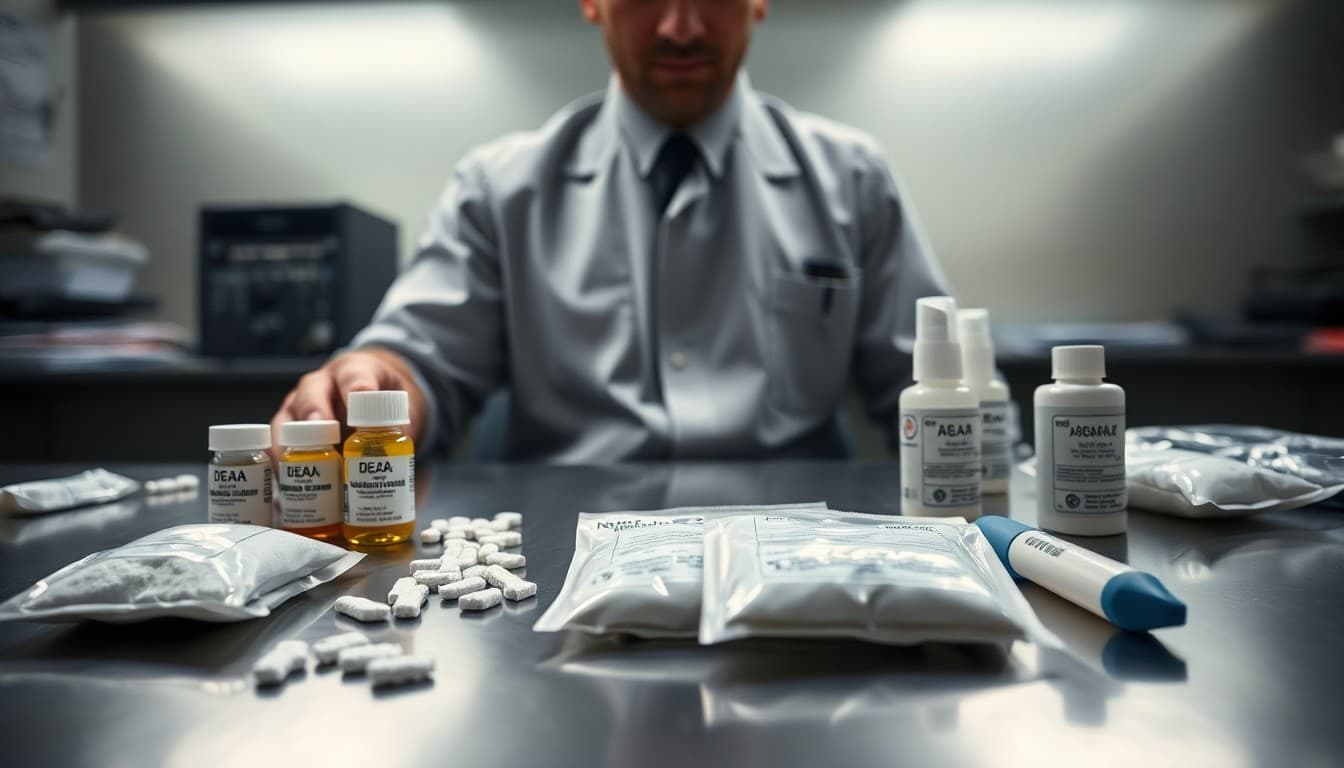
DEA Warns Fentanyl Is Increasingly Laced With Veterinary Tranquilizers, Creating 'Naloxone-Resistant' Overdose Crisis
The Drug Enforcement Administration issued an urgent public safety advisory this month warning that illicit fentanyl is increasingly being adulterated with powerful veterinary tranquilizers—creating overdose scenarios that standard emergency protocols cannot reverse and complicating an already devastating public health crisis.
The May 12, 2026 advisory highlights a dangerous evolution in America's drug supply: fentanyl, already responsible for the majority of overdose deaths, is now routinely mixed with xylazine and the even more potent medetomidine. Both substances are alpha-2 adrenergic agonists used in veterinary medicine—xylazine as a sedative for horses and cattle, medetomidine primarily for large exotic animals including rhinoceroses. Neither drug is approved for human use. Neither responds to naloxone.
The Clinical Nightmare First Responders Now Face
For decades, naloxone has been the cornerstone of overdose response. The medication reverses opioid-induced respiratory depression, often restoring breathing within minutes and buying critical time for emergency medical care. But xylazine and medetomidine operate through entirely different biological mechanisms, targeting alpha-2 receptors rather than opioid receptors. When fentanyl is mixed with these sedatives—a combination increasingly common in street drugs across the United States—naloxone may reverse the opioid component while leaving the patient deeply sedated, with dangerously suppressed breathing and heart rate.
An NPR investigation in April documented clusters of overdoses involving medetomidine in which responders administered standard or even repeated naloxone doses without restoring respiration. The victims remained unconscious, their airways compromised, requiring intensive airway management and mechanical ventilation that few bystanders or even some emergency responders are equipped to provide.
Dr. Emily Keller, Maryland's Special Secretary for Opioid Response, described the emerging pattern in stark terms during a recent public health briefing: "We're seeing patients who should have responded to naloxone. They've got the opioid component reversed, but they're still down. Still sedated. Still not breathing effectively. It's creating a treatment gap we didn't have before."
From 'Tranq Dope' to 'Rhino Tranq'
Xylazine, known on the street as "tranq" or "tranq dope," first appeared in the U.S. drug supply in the late 2010s, primarily in Puerto Rico before spreading to Philadelphia and other East Coast cities. By 2024, the DEA detected it in 48 states. The drug causes profound sedation lasting hours longer than fentanyl alone, and is associated with severe necrotic wounds that can develop at injection sites—or even distant from them—sometimes requiring amputation.
Medetomidine represents a newer and potentially more dangerous addition. Approximately 100 to 200 times more potent than xylazine in its sedative effects, medetomidine was developed for veterinary procedures requiring deep, sustained anesthesia in large animals. When diverted into the illicit drug supply, it creates unpredictable sedation that can outlast fentanyl's effects by many hours.
Forensic toxicologists have identified medetomidine in overdose deaths across multiple states, often in combination with xylazine and fentanyl—a triple threat that challenges every aspect of emergency response. The withdrawal syndrome from medetomidine is also distinct and severe, characterized by potentially life-threatening spikes in blood pressure that complicate medical management.
Geographic Disparities in an Evolving Crisis
The DEA advisory arrives amid contradictory trends in overdose mortality. Nationally, drug overdose deaths fell approximately 14% in 2025, marking the third consecutive year of decline from the pandemic peak of nearly 110,000 annual fatalities. Public health officials credit expanded naloxone distribution, growth in medication-assisted treatment access, and disruptions to fentanyl precursor supply chains.
But these gains are unevenly distributed—and potentially fragile. While states like New York report 45% reductions in overdose deaths since 2022, New Mexico, Arizona, and Colorado have seen mortality increase by more than 10%. The Mountainair, New Mexico incident in late May, where an unknown substance killed three people and hospitalized more than 18 first responders, illustrates how quickly novel adulterants can overwhelm local response capacity.
Forensic chemists identified 23 new synthetic opioid analogues in seized materials during the first five months of 2026—more than were catalogued in all of 2024. This "chemical cat and mouse" dynamic, where traffickers constantly modify drug compositions to evade detection and stretch profits, means the supply is becoming more pharmacologically complex even as overall potency trends remain dangerous.
Harm Reduction Adapts to New Realities
The emergence of naloxone-resistant sedatives is forcing rapid adaptation across harm reduction services. Syringe service programs are expanding wound care capabilities to address xylazine-related injuries. Some programs now distribute xylazine test strips, though these provide no protection against medetomidine, which requires different detection methods.
Most critically, overdose response training is evolving to emphasize that naloxone administration—while still essential—may not produce the dramatic revival that bystanders have come to expect. Responders are being taught to maintain rescue breathing for extended periods, sometimes 30 minutes or longer, while awaiting emergency medical services. The "never use alone" message, long central to harm reduction messaging, has taken on renewed urgency.
Yet these adaptations face significant policy headwinds. The Trump administration's April 2026 ban on federal funding for drug test strips—part of a broader shift away from harm reduction approaches—directly contradicts the DEA's own warnings about evolving supply dangers. Public health advocates argue that restricting tools for detecting adulterants while simultaneously warning about those same adulterants creates a dangerous policy paradox.
Treatment Implications for Addiction Medicine
The changing drug supply also complicates addiction treatment. Patients using fentanyl-xylazine or fentanyl-medetomidine combinations present with withdrawal syndromes that standard medication-assisted treatment protocols were not designed to address. Buprenorphine and methadone, effective for opioid withdrawal, do not alleviate alpha-agonist withdrawal symptoms—which can include severe hypertension, anxiety, and prolonged insomnia.
Treatment providers report that patients using tranq-adulterated drugs often require longer detoxification periods and more intensive medical monitoring than those using opioids alone. The Yale School of Medicine's recent consensus guidelines for hospital-based addiction treatment, published in JAMA Network Open, specifically address these challenges, recommending extended observation periods and adjunctive medications for managing complex withdrawal.
For outpatient treatment programs, the implications are equally significant. Patients stabilized on buprenorphine who continue using street fentanyl may now be exposed to unpredictable sedative effects that increase overdose risk even among those with opioid tolerance. Counseling protocols are being modified to address these specific dangers, but implementation varies widely across treatment settings.
The Enforcement Dilemma
The DEA's advisory highlights a fundamental tension in drug policy. Enforcement efforts targeting fentanyl production and distribution have succeeded in disrupting some supply chains—potentially contributing to the recent mortality decline. But these same pressures appear to be driving adulteration with cheaper, legally available veterinary drugs that are easier to obtain and harder to interdict.
Xylazine remains unscheduled at the federal level, though several states have moved to restrict its sale. Medetomidine, as a prescription veterinary medication, is subject to some controls but is widely available through legitimate veterinary supply chains. Neither substance is included in standard drug testing panels, making surveillance difficult.
The DEA has indicated it is evaluating scheduling recommendations for xylazine, which could provide additional enforcement tools. But public health experts caution that supply-side interventions alone cannot address the underlying dynamics driving adulteration. As long as profit motives incentivize stretching fentanyl with cheaper alternatives, the drug supply will continue evolving—often in directions that increase rather than decrease risk.
What Comes Next
The 2026 overdose decline represents genuine progress in a crisis that has claimed more than half a million American lives over two decades. But the DEA's warning about veterinary tranquilizers illustrates how fragile these gains may be. Each adaptation in the illicit drug supply introduces new clinical challenges that existing public health infrastructure is not fully equipped to address.
For people who use drugs, the message is increasingly complex: carry naloxone, but understand its limitations. Never use alone, and ensure someone present knows rescue breathing. Test drugs when possible, but recognize that test strips cannot detect every threat. Seek treatment, but be prepared for withdrawal management that may be more complicated than in previous years.
For policymakers, the advisory underscores the need for approaches that can adapt as quickly as the supply itself. Static interventions—whether enforcement strategies, treatment protocols, or harm reduction services—risk becoming obsolete as drug compositions change. The ability to monitor, detect, and respond to emerging adulterants in real time may prove as important to reducing mortality as any single intervention.
The opioid crisis has always been a moving target. The DEA's warning makes clear that it is moving faster than ever—and in directions that challenge everything we thought we knew about overdose prevention and response.
If you or someone you know is struggling with substance use, help is available. Call the SAMHSA National Helpline at 1-800-662-HELP (4357) for confidential, free treatment referral and information.
Editorial Board
Editorial review using SAMHSA, CDC, CMS, and state agency sources
The NWVCIL editorial team reviews and updates treatment-center information using public data from SAMHSA, CDC, CMS, and state behavioral-health agencies. We cross-check facility records, state coverage rules, and clinical-practice updates so the directory reflects current evidence and policy.
Related Articles

Fentanyl Deaths Plunge 54% from Peak as U.S. Overdose Fatalities Decline Sharply
CDC provisional data show fentanyl-related deaths dropped 54% from their peak, with total overdose fatalities falling to approximately 70,000 in 2025—a third consecutive year of decline.

Utah Detects Medetomidine in Illicit Drug Supply, Expanding Veterinary Sedative Threat
Utah health officials confirm medetomidine, a potent veterinary sedative, has been detected in the state's illicit drug supply, creating naloxone-resistant overdoses and severe withdrawal symptoms.

CDC Report: Nearly 10,000 Drug Overdose Deaths Occurred in Hotels and Motels Over Three Years
New CDC data reveals 9,651 overdose deaths in hotels and motels from 2022-2024, with 56% involving local residents. Report highlights critical gaps in bystander response and naloxone access.